
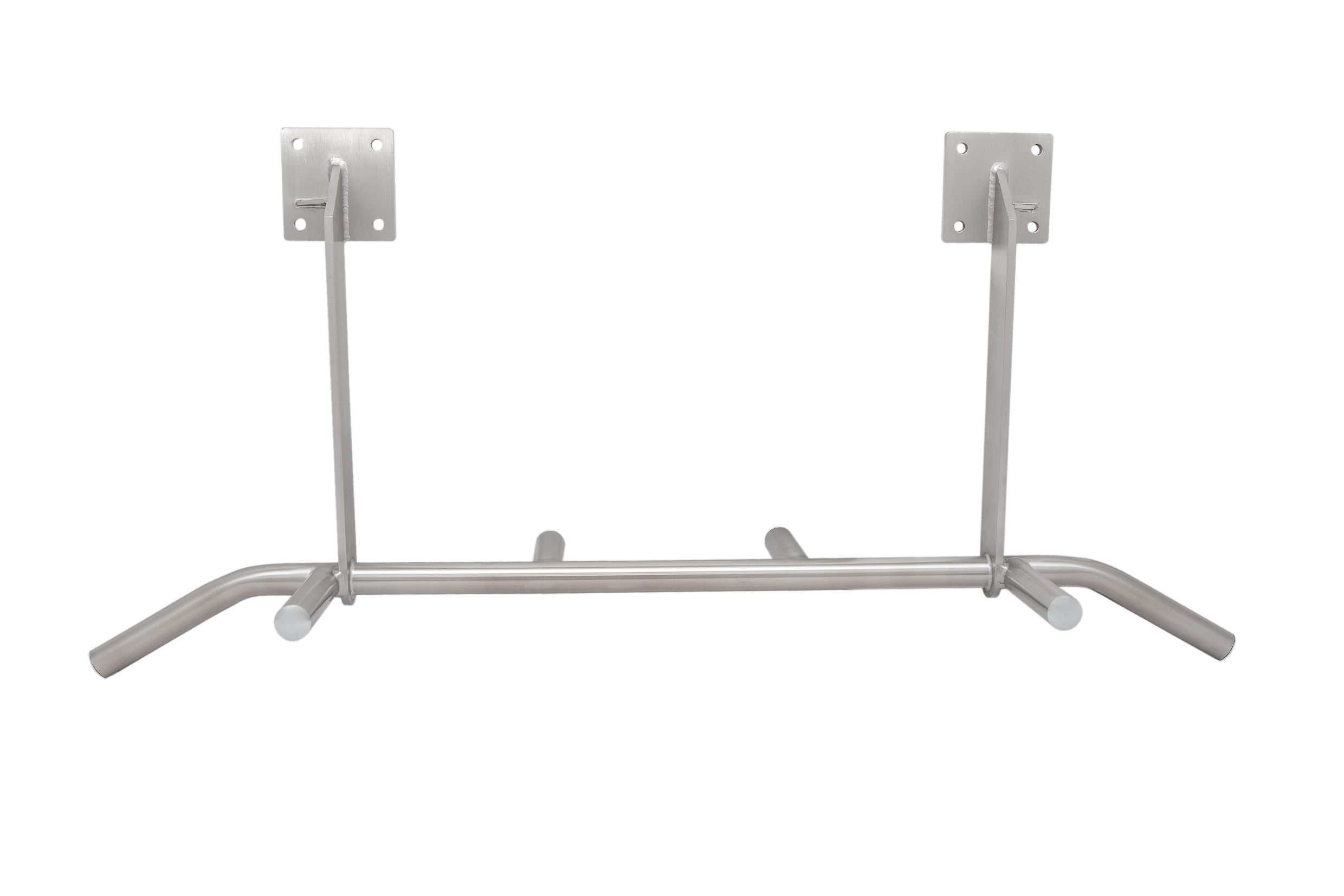
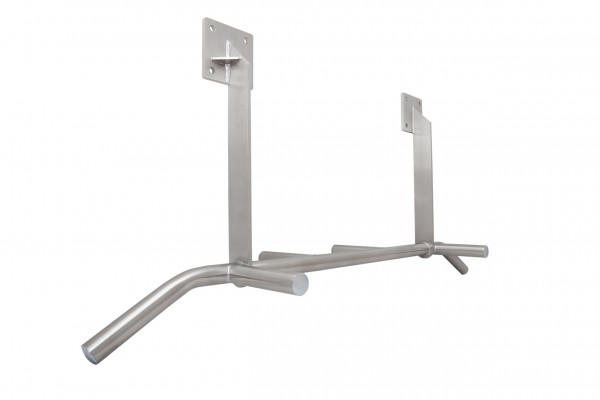
B4 Pull-Up Bar for Beam Mounting



Prices incl. VAT plus shipping costs
- Einfache und schnelle Montage
- Robust und pflegeleicht
- Rutschfestes Material


- Order number: 00B4-1200.1
The B4 pull-up bar for beam mounting is highly minimalist, extremely robust, offers multiple grip variations, and can be attached to all beams with a lateral height of at least 15 cm.
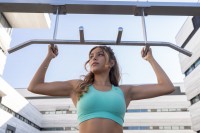
Pull-ups are an essential part of any training program. With this pull-up bar, the space underneath a beam can also be utilized for pull-ups. This is exactly what the pull-up bar was developed for.
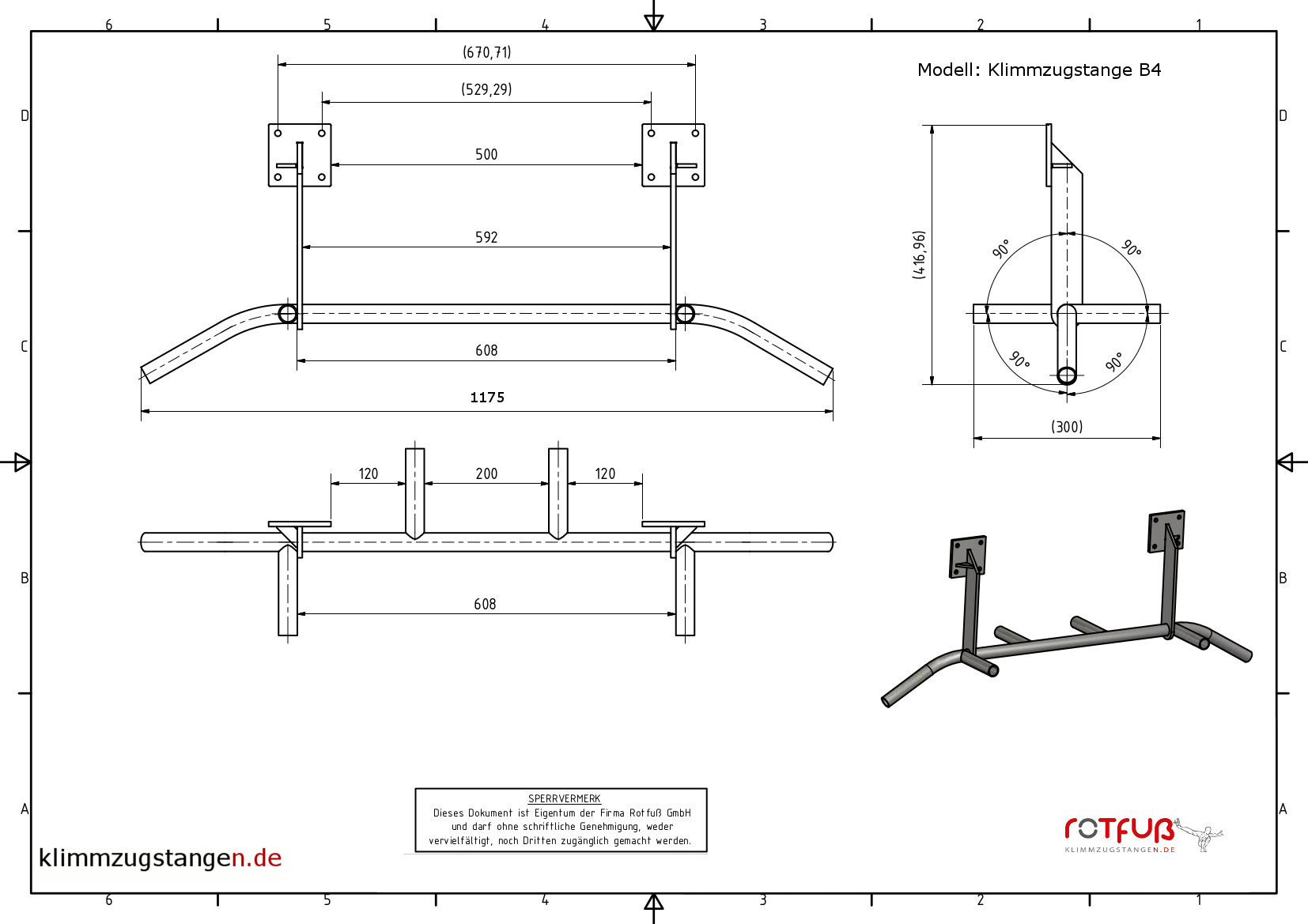
The pull-up bar is manufactured from high-quality, rust-resistant stainless steel - with up to four additional grips/parallel grips. The pull-up bar has a diameter of Ø 30 mm. The tube is curved and is located 290 mm below the lower edge of the mounting plate (i.e., the internal clearance is 290 mm, the total length of the vertical struts is 400 mm).
The total width of the pull-up bar is 118 cm, enabling between two and four grip variations and up to five different pull-up variations.
The pull-up bar consists of a single piece, meaning it is fully welded and requires no assembly. The tube is embedded into the 8 mm thick and 50 mm wide struts and welded on both sides. The brackets are inserted centrally into the square 10 x 10 cm plates, double-welded - on both sides - and additionally reinforced. This construction ensures a load capacity of up to 500 kg and allows for a 20-year warranty.
Key features of the pull-up bar for beam mounting
-
Material: high-quality, rust-resistant stainless steel
-
Design: practical, straightforward, clear, and minimalist at the same time
-
Construction: extremely robust, fully welded - no assembly required
-
Tube: straight or curved, ends fitted with matching end caps
-
Additional grips: four, two, or none - at least two additional grips are recommended
-
Mounting: eight screws
-
Surface: brushed
-
Load capacity: up to 500 kg
-
20-year warranty on welding seams (further details upon request)
The pull-up bar for beam mounting also offers
-
Optimal dimensions for every pull-up workout
-
360° action radius for versatile exercises
-
Maximum safety and load capacity up to 500 kg
-
Very long service life
-
Professional quality with expert welding seams
-
24/7 availability on the beam, making regular assembly and disassembly obsolete
-
Easy expansion with a sling trainer, resistance band, fitness mat, and gymnastic rings into a personal fitness room, home gym, or fitness corner
Dimensions (for other dimensions and customizations, please refer to the Customized B-Model)
-
Width x depth x height: 118 cm x 30 cm x 42 cm (base model B4, with four additional grips)
-
Internal clearance between the lower edge of the square bracket and the tube: 290 mm
-
Tube diameter: Ø 30 mm
-
Maximum grip width: 118 cm
-
Length of additional grips/parallel grips: 13 cm
-
For base models with additional grips: distance between narrow parallel grips 23 cm, distance between wide parallel grips 60 cm
-
Strut width and thickness: 50 mm and 8 mm
-
Square plates: 10 x 10 cm, with 4 holes each
-
Distance between square plates: 70 cm (outer), 60 cm (center), 50 cm (inner)
-
Diameter of drill holes for screws: Ø 10 mm
Technical Details
-
Condition: new
-
Made in: Germany
-
Number of components: 1 piece
-
Construction: fully welded
-
Number of drill holes for screws: 8 pieces, Ø 10 mm
-
Ends: closed with matching end caps
-
Surface: brushed, grit size 240
-
Color: stainless steel
-
Weight: 5.9 kg
Customer photos: Pull-up bar for beam mounting
Below, several customer images showcasing the pull-up bar for beam mounting are provided.
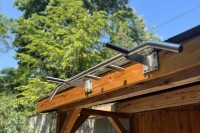
Pull-up bar for beams with straight ends and without additional grips, mounted in a roof truss


The best exercises on the B4 pull-up bar
Below are 7 exercises that are possible on the B4 pull-up bar. The description focuses only on the essentials. Selected exercises can also be seen in the embedded videos.
Pull musculature / Pull exercises
#1 Classic pull-ups (= Pull-ups, Chin-ups)
For a classic pull-up, the pull-up bar is gripped with both hands, the arm and back muscles are tensed, and the body is pulled upwards, first from the shoulders and then from the arms, until the chin is slightly above the bar. This position is held for 1-2 seconds. The body is then lowered slowly and in a controlled manner until the arms are fully extended.
Classic pull-ups are pull exercises to strengthen the back or the entire upper body. They can be performed using various grip types and widths and combine very well with other exercises.
The two most common grip types are the overhand grip (= pronated grip, i.e., the back of the hands face the user) and the underhand grip (= supinated grip, i.e., the palms face the user).
In most workouts and training sessions, classic pull-ups are usually performed shoulder-width apart using an overhand grip. However, gripping the bar can generally be done at different widths, e.g., 110 cm, 60 cm, or 10 cm.
Pull-ups refer to classic pull-ups using an overhand grip. Chin-ups refer to classic pull-ups using an underhand grip.
#2 Negative pull-ups or pull-up holds in an underhand grip
Negative pull-ups: Jump from a normal standing position to the pull-up bar so that the chin is slightly above or directly at the pull-up bar. The position is held for 1-2 seconds. The body is then lowered slowly and in a controlled manner until the arms are fully extended. Finally, a jump is made from the pull-up bar back to the ground into a normal standing position. Important: The body must be tensed throughout the entire range of motion.
Pull-up holds in an underhand grip: The pull-up bar is gripped in an underhand grip (thumbs pointing outwards), the legs are fully extended and pressed together. From this position, the body is pulled upwards until the chin is above the pull-up bar. This position is held for 1 - 2 seconds. The body is then lowered slowly and in a controlled manner. At the end of the movement, the position is held briefly before pulling the body upwards again until the chin is above the pull-up bar. Possible training unit: Performing as many pull-up holds as possible in one minute.
Negative pull-ups and pull-up holds in an underhand grip are ideal exercises for beginners. They are highly recommended if not a single classic pull-up can be achieved yet. Negative pull-ups can also be performed in an overhand grip.
#3 One-arm pull-up
The pull-up bar is gripped with one arm on a straight section using an underhand grip. The arm and back muscles are tensed. The upper body is then pulled up and simultaneously turned towards the gripping arm. The turning movement is initiated with the shoulder.
Note: When performing the one-arm pull-up with the left arm, the body is turned to the left when pulling up.
Abdominal and core musculature
#1 Burpee pull-up (= Burpees with pull-ups or push-up-jump-pull-up combination)
Starting position: Normal shoulder-width stance.
Step 1: Move from a normal stance into a squat so that the palms touch the floor.
Step 2: Jump from this position into a push-up position (jump slightly upwards and simultaneously extend the legs backward until they are fully extended and the toes touch the floor).
Step 3: Jump immediately from the push-up position back into a squat and then upwards from the squat to the pull-up bar. The pull-up bar is gripped with both hands during the jump, and the chin is pulled above the bar. This position is held for 1-2 seconds.
Step 4: The body is then lowered slowly until the arms are fully extended, followed by a jump back to the floor into the starting position.
The burpee pull-up combines several exercises (squats, push-ups, vertical jumps, pull-ups) into one fluid movement. The burpee pull-up (or burpees in general) is one of the best exercises in bodyweight training and calisthenics.
The burpee pull-up provides an easy way to determine or check the current fitness level. The following assessment serves as a good orientation:
-
8 or fewer burpees: poor
-
10 burpees: average
-
12 burpees: good
-
13 or more: excellent
#2 Leg raises on a pull-up bar
The pull-up bar is gripped shoulder-width apart in an overhand or neutral grip. The knees are raised upwards so that both legs and the upper body form a 90° angle. The legs are then lowered in a controlled manner.
Variation: The knees can also be pulled towards the chest to achieve a larger range of motion. The intensity is increased by lifting straight instead of bent legs.
#3 Windshield wipers
The pull-up bar is gripped shoulder-width apart in an overhand or neutral grip. The legs are raised upwards until the body and legs form a V-shape. The legs are then rotated alternately to the left and then to the right (similar to the movement of a car's windshield wiper).
This exercise provides an excellent stimulus for the oblique abdominal muscles. It can also be performed on dip bars.
#4 Front lever
The same starting position is assumed as for the windshield wipers. The fully extended legs are carefully lifted until the upper body and legs form a straight line. The position is held for 2-8 seconds. The legs are then carefully lowered back to the starting position.
The front lever can also be performed very effectively on dip bars.
Requirements for effective fitness training: time, fitness equipment, space, training plan, and training goal
For effective fitness training at home, only a little time 1-2 times a week, the right fitness equipment, some space, a training plan, and a training goal are required. How to properly select these elements and what needs to be considered is described below. Except for the reference to the required space, the same naturally applies to training in a CrossFit box or a gym.
Training goal
Defining a training goal is not difficult. In the simplest case, it works like this: Assuming the objective is to improve general fitness. In this scenario, the training goal would simply be the improvement of general fitness.
Example of a training goal: Improvement of general fitness.
Why is a training goal necessary? In fitness, the basic rule applies: no training without a training goal. A personal trainer always asks for the training goal first and creates a training plan based on it. If professionals always work based on training goals, this approach can easily be adopted. It is not complicated and only requires some basic knowledge of the biophysical processes in the body.
Training plan
If the objective is to improve general fitness, a possible training plan would be:
Complete about 1 hour of general fitness training 1-2 times a week, ensuring that the physical limit is reached in 1-2 exercises.
Possible exercises would then include: jumping jacks, jump rope, squats, push-ups, prone rows, burpees, all types of pull-ups (with and without assistance), crunches, leg raises, and 30-45 minutes of running, cycling, or swimming.
The number and volume of the individual exercises can be determined individually. The intensity of specific exercises can also be set, adjusted, or refined over time. Warming up before every workout and stretching the muscles afterward is absolutely essential. This prevents injuries and promotes recovery.
A training plan consisting of one set with 5-10 repetitions, 2-3 exercise sets, and 3-5 different exercises works quite well.
The training goal is approached closer when the physical limit is reached at least 1-2 times during the workout. The more frequently this happens, the better it is for muscle growth. Only this stimulates the body to build muscle. Otherwise, the fitness level is merely maintained and not improved. An alternative for the same duration would be a few exercises with many repetitions and low intensity. A 45-minute run would be an example of such an exercise.
Furthermore, proper nutrition and sufficient sleep are important for achieving the training goal. This allows the body to recover faster and be more resilient during the next workout.
Space
Naturally, some space is required for varied fitness training. This can be the living room, hallway, study, basement, or even the bathroom. If outdoor training is preferred, a terrace, carport, or garden often provides sufficient space.
An area of at least 5 sqm or 1.5 m x 3 m already allows for many exercises. The space should at least accommodate jumping rope, push-ups, or jumping jacks. 10 sqm and more are obviously better. Between exercise sets, it is helpful to walk around a bit, gather thoughts, and mentally prepare for the next exercise.


Fitness equipment
For effective fitness training at home, fitness equipment can initially be completely omitted. Without prior training, the physical limit is quickly reached even without equipment. For example, the following can be tried: 10 push-ups distributed over three sets, 10 burpees as one set, or 20 prone rows with the arms distributed over four sets.
Over time, any training without fitness equipment becomes monotonous or must be very well thought out to ensure a balanced full-body workout.
Experience has shown the following equipment to be highly effective for general fitness training:
-
Jump rope
The assortment includes, for example, highly stable and minimalist pull-up bars and dip bars for fitness training, which can also be perfectly used in a living room without needing to be hidden.

Time
To improve general fitness, training 1-2 times a week for about 1 hour each time is completely sufficient. While this training duration will not create a superhero, it definitely leads to a high level of fitness.
It is important that training is done regularly. The body needs time to adapt to the new load. The longer the training rhythm is maintained, the longer the fitness level can be sustained.
Training results are often visible faster in men than in women, frequently after just the first 2-3 weeks. Generally, women need to train more to achieve the same level.
When asking people who have been exercising regularly for years how they manage it, the answer is often: make fitness training a fixed part of daily life, just like brushing teeth, showering, or bathing. It is really nothing more than that.
In the long run, it is therefore very helpful to get properly organized. This can be achieved, for example, by setting a fixed training time, establishing a dedicated fitness corner, building a home gym in the living room, or setting up a small calisthenics park in the garden.
If this is not possible, a gym membership or a nearby calisthenics park can provide an excellent alternative.
Summary
A training goal, a training plan, some space for training, the right fitness equipment, and a little time 1-2 times a week are fundamental for effective fitness training. To ensure that the fitness training does not lead to any unpleasant surprises, warming up before the workout and stretching the muscles afterward is crucial. Additionally, attention should be paid to proper nutrition and sufficient sleep.
Assembly instructions – B4 pull-up bar (mounting on a wooden beam)
These instructions describe the professional installation of the B4 pull-up bar on a wooden beam.
Important note on pre-drilling
When attaching a pull-up bar to a wooden beam, the holes must be pre-drilled.
-
Used screws: 8 mm lag screws
-
Recommended drill bit: 4 mm wood drill bit
-
Purpose:
Pre-drilling relieves the tension in the wood caused by driving in the screws and prevents cracks in the beam.
Required tools
-
Cordless screwdriver
-
Wood drill bit 4 mm
-
Ratchet with a 13 mm socket
-
Spirit level
-
Pencil or a suitable marking pen
Step-by-step assembly
1. Determining the position
The pull-up bar is held in the desired position on the wooden beam.
2. Marking the first hole
-
An outer hole of the mounting plates is selected.
-
It does not matter whether:
-
the right or left mounting plate is used
-
the upper or lower outer hole is used
-
-
It is only important that it is an outer hole.
The hole is marked cleanly with a pencil or marking pen.
3. Drilling the first hole
-
Drilling is done precisely in the center of the mark.
-
Drilling diameter: 4 mm
-
Drilling depth: approx. 60 mm
-
Important:
-
The drilling must be straight.
-
The cordless screwdriver is held at a 90° angle to the surface.
-
Do not drill diagonally upwards, downwards, or sideways.
-
4. Inserting the first lag screw
-
The pull-up bar is held against the beam again.
-
The 8 mm lag screw is driven through the mounting plate into the pre-drilled hole.
-
A ratchet with a 13 mm socket is used for this step.
The screw is driven in until:
-
it is securely seated.
-
the pull-up bar can still be moved slightly.
-
a gap of approx. 1 mm is left between the washer and the mounting plate.
Initial situation:
The B4 pull-up bar is now hanging down from one screw.
5. Aligning with a spirit level
-
The spirit level is placed on the middle tube of the pull-up bar.
-
The bar is aligned horizontally until the spirit level is perfectly balanced.
-
The opposite outer hole is then marked.
6. Drilling the second hole
-
The pull-up bar is carefully lowered.
-
The second hole is drilled as before:
-
4 mm diameter
-
approx. 60 mm deep
-
90° to the surface
-
7. Inserting the second lag screw
-
The pull-up bar is pushed back up.
-
The second lag screw is inserted.
-
It is not fully tightened yet.
Before final tightening:
-
The spirit level is applied again.
-
Minor corrections are made if necessary.
Note:
The mounting plates have 10 mm holes, while the lag screws have an 8 mm diameter.
This provides approx. 1 mm of play on each side to align the pull-up bar perfectly.
8. Drilling the remaining holes
Once the pull-up bar is aligned horizontally:
-
The remaining 6 holes can be drilled directly.
-
The pull-up bar no longer needs to be removed.
9. Tightening all screws
-
All remaining lag screws, including washers, are driven in.
-
They are tightened evenly.
-
Recommended tightening torque: approx. 25 Nm
Completion
The installation is successfully completed.
The home gym is now ready for use.
Please note:
A fit and healthy body cannot be bought –
it requires continuous training, diligence, and discipline.
What is the internal clearance between the tube and the beam?
The standard internal clearance to the beam or to concrete protrusions is approx. 29 cm.
Is mounting material included in the scope of delivery?
Yes and no, as it can be selected optionally. Mounting material can also be added to the shopping cart separately here.
Is there an optimal mounting height? How high should the pull-up bar hang above the floor?
Yes, the pull-up bar should ideally hang 30% above body height. In this case, the floor will no longer be touched while hanging. This means, for example, with a body height of 1.8 m, the pull-up bar should hang 2.34 m above the floor. Generally, the following formula applies: Ideal mounting height = Body height * 1.3. If the ceiling height does not allow this, the legs must be slightly bent.
What is the diameter of the pull-up bar?
The diameter of the pull-up bar at all grip points is 3 cm or 30 mm.
Are the grip ends knurled, roughened, or polished?
All grip ends are neither knurled nor roughened. They are brushed or ground with 240 grit. This means they are slightly rougher than polished.
Can the pull-up bar also be mounted on wood?
Yes, using screws with a wood thread and without dowels. The wood should be pre-drilled, for 8 mm screws with a 3 to 4 mm drill bit. The wood or beam should be sturdy and have a sufficiently large contact surface for the mounting plates. The drill holes should be approx. 2 cm away from the edge to prevent the wood from splintering.
Can the concrete mounting set also be used on a wooden beam?
Yes, but the dowels are not required for this. The 8 mm lag screws in this set also have a wood thread and can be driven directly into the wood. For this, the wood only needs to be pre-drilled with a 3 to 4 mm wood drill bit.
Does the maximum load capacity of 500 kg include the person's weight?
The maximum load capacity refers to the maximum possible weight that the user may apply.
Can the distance between the struts be changed?
Yes. With a curved 118 cm long tube, the struts can be placed and welded a maximum of 83 cm apart. With a straight tube, they can be placed up to 1 cm from the end of the tube. It can be checked in the configurator whether this modification is offered as standard. If not, a brief message via the contact form is recommended.
Is the pull-up bar also suitable for outdoor use?
Yes, the pull-up bar is predestined for outdoor installation but can also be used indoors, as it is made of high-quality stainless steel.
It should be noted that the pull-up bar must not be installed in a maritime atmosphere, i.e., near a sea or ocean (e.g., the North Sea coast, Baltic Sea coast, or Atlantic coast).
Can the pull-up station also support a punching bag? Can the pull-up bar hold a punching bag additionally?
Yes, a punching bag can be attached to the pull-up bar without any problems. This can be done directly on the tube using a round sling and a carabiner. To prevent the punching bag from slipping, an eyelet can also be welded to the pull-up bar, see here: Pull-up bar with one or more eyelets.
Is the pull-up bar also available in white or another color?
No, the pull-up bar is currently not available in white or any other color.
Can the ceiling pull-up bar also be mounted on a wall?
No, because it has curved ends. Reason: The curved ends would not be usable. Additionally, the pull-up bar could break out of the wall, especially if it is not a solid concrete wall, because the leverage forces could become too great. Overall, this is not recommended.
Is the actual pull-up bar also made of solid steel?
No, the pull-up bar itself is made of a tube with a wall thickness of 2 mm.
Are the blanking plugs made of the same metal as the pull-up bar and firmly welded on?
No, the blanking plugs are made of polyamide with a stainless steel look (coated plastic) and are therefore not firmly welded on. They feature the same color as the pull-up bar and are driven into the tube.
Blanking plugs are damaged. What to do?
Contact can be made via the contact form, providing the corresponding order number. New blanking plugs will then be sent out.
Technical Specifications
| Grip options | 6 grip variations (1 x curved ends; 3 x straight section: wide, medium, narrow; 2 x neutral grip: narrow, wide) |
| Width x depth x height | 118 cm x 30 cm x 38 cm |
| Maximum grip width | 118 cm |
| Grip diameter | Ø 30 mm |
| Distance between wide parallel grips | 60 cm |
| Distance between narrow parallel grips | 23 cm (center) |
| Length of additional grips | 13 cm |
| Strut width and thickness | 50 mm and 8 mm |
| Mounting plates | 100 x 100 mm, with 4 drill holes each, placed 1.5 cm from the edge |
| Diameter of drill holes for screws | Ø 10 mm |
| Possible exercises | Classic pull-ups (5 grip variations): wide/medium/narrow, in overhand, underhand, or neutral grip (= pull-ups, chin-ups, neutral pull-ups), burpee pull-ups, leg raises, L-sit pull-ups, front lever, back lever, negative pull-ups, neutral pull-ups, one-arm pull-ups. |
| Weight | 9 kg |
| Material | High-quality stainless steel (DIN 1.4301) |
| Surface | Brushed / ground (grit size 240) |
| Load capacity | 500 kg (concrete ceiling) |
| Permitted use | Only suitable for general fitness training, calisthenics, and bodyweight exercises indoors or outdoors (indoor + outdoor). |
| Warranty | 20 years |
| Condition | New |
| Manufacturer | klimmzugstangen.de |
| Made in | Germany |
| Scope of delivery | 1 B4 pull-up bar (with four additional grips, 1 x wide, 1 x narrow). Optionally with mounting material. |