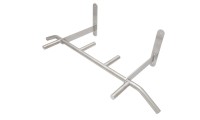

A few months ago, the images shown were received from a customer, along with a polite request to exchange the dip bars because they arrived severely deformed and non-functional. The extent of this damage was astonishing and completely unexpected.

Such damage has not been seen at klimmzugstangen.de in the last 15 years. This incident completely overturns previous understandings of the logistics processes of parcel delivery services and the final mile of delivery.

If metal specialists, logistics experts, or parcel delivery personnel have a possible explanation or an idea of what massive forces must have acted on the Tungsten Inert Gas (TIG) welded stainless steel tube (Ø30 mm, t=2 mm) to cause the damage shown in the picture, reaching out with an explanation would be highly appreciated.

Not much can be said about the exact circumstances. The package arrived, and it was not initially noticed that the box was damaged. It was accepted, and the damage was only discovered during unpacking. By that time, the delivery driver had long since left. Once the package was returned, it was clearly visible that an external force must have acted upon it. The package was damaged on the corresponding side.
It is strongly suspected that a forklift, a truck, or another large machine came into contact with the package. From an objective standpoint, a machine must definitely have been involved here.
Bending the dip bars with bare hands or body weight during training is simply impossible. The dip bars are designed to easily withstand a load of 200 kg per bar, meaning a pair can carry a total of 400 kg. Each individual foot can thus be loaded with 50 kg.
Standards, Technology, Quality, Design, and Manufacturing
At klimmzugstangen.de, extreme attention is paid to the technology, quality, and design of the products. If compared to the automotive sector, these products represent the premium segment—akin to Porsche, BMW, or Mercedes-Benz—among pull-up bars and dip bars.
With this high standard, the products are designed with extra safety margins, high-quality individual components are deliberately used, and meticulous attention is paid to the manufacturing result. All this ensures that the quality, the internal standards, and the user experience are never compromised.
Recurring defects and process errors in shipping—the final mile of delivery—have been eliminated over several years through iterative loops in the Poka-yoke style. The initial problem was that packages repeatedly arrived damaged. Handing over a high-quality product to service providers (DHL, GLS, and other logistics companies) with the knowledge that 10 out of 100 packages would be delivered damaged was unacceptable. This error rate of 10% has now been reduced to under 1%.
Reason for the Damaged Packages
The reason for the damaged packages was analyzed as follows: Delivery personnel, who often possess considerable physical strength, sometimes handle packages with excessive force. Shipments are thrown into delivery vehicles, onto conveyor belts, or even tossed over distances if a conveyor belt happens to be stuck.
Based on this realization, an internal packaging structure was developed that secures the products inside the box in all directions. This measure was highly successful and immediately reduced the damage rate to the very low level seen today.

However, even the best packaging offers no protection against the extreme bending shown above. Since such massive impacts are theoretically possible during delivery, dip bars and pull-up bars would strictly speaking need to be shipped in armored containers to guarantee a 100% undamaged arrival.
Current Solution
An armored shipping method is, of course, neither economical nor practical. For this reason, there is currently no choice but to accept such rare extreme cases. At the same time, it is strongly requested that packages always be carefully inspected upon acceptance. Any damage to the box or product should be immediately reported to the delivery driver. If necessary, the package should only be accepted with reservations, or in case of doubt, acceptance should be completely refused.
In practice, this means: The delivery driver must be informed that acceptance is refused due to obvious damage, unless the contents are checked together for damage. If agreed, the package should be opened in the presence of the driver and the contents inspected. This ensures that the facts are documented correctly and in a legally secure manner for all parties involved.
For customers from the surrounding area (northern Baden-Württemberg), there is also the option to pick up orders personally on-site (in 74834 Elztal). This is currently the only absolute guarantee to completely rule out any transport damage.