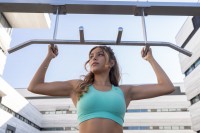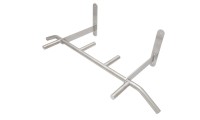


Simply hanging from a pull-up bar is a highly effective exercise, even for beginners. This article explains what decompressing your back can do for you.
Benefits of the Dead Hang
Decompressing your back by hanging offers several benefits for your health and fitness. The most important advantages are:
-
Strengthening shoulders and arms: Hanging from a pull-up bar engages the muscles in your shoulders, upper arms, and back. Regular hanging increases strength in all these areas of the body. Additionally, ligaments, tendons, and cartilage are put under healthy stress. With regular load, they also adapt, becoming more resilient and less prone to injury.
-
Relief from shoulder problems: If you suffer from shoulder pain, controlled hanging from a pull-up bar can help stretch and strengthen the musculature in the shoulder region. This contributes to pain relief and helps prevent injuries.
-
Improving grip strength: Hanging from the pull-up bar trains your grip strength. Regular hanging thereby also increases the power in your forearms and hands. This is very advantageous for other exercises like pull-ups or deadlifts.
-
Decompressing the spine: Prolonged hanging from a pull-up bar relieves the spine. Specifically, hanging decompresses the spine, reduces the pressure on intervertebral discs, and counteracts vertebral blockages. For instance, each of us is slightly taller shortly after getting up than at the end of the day. Cosmonauts and astronauts also grow by up to 3 percent or 7.6 centimeters within the first 24 hours in space due to the lack of gravitational pressure, causing the discs to expand [1]. Any relief of the spine helps with back pain or tension.
-
Improving posture: By hanging and strengthening your shoulder and back muscles, you can improve your posture and correct postural issues caused, for example, by long periods of sitting at a desk.
-
Increasing blood circulation: Hanging from a pull-up bar increases blood circulation in the arms and shoulders, which promotes the supply of oxygen and nutrients to the muscles.
-
Relaxation and stress reduction: Hanging can also help reduce stress and promote relaxation, as it stretches the musculature and increases overall well-being.
The dead hang is a very simple back exercise. Note, however: You should only perform back hangs carefully at the beginning. This is especially true if you already have existing health problems like shoulder pain. Furthermore, all the above-mentioned benefits only manifest if you hang regularly for at least 2 to 6 weeks.
Of course, you can perform dead hangs not only on pull-up bars but also on gymnastic rings or other suitable mounts and anchor points.
In case you didn't know: Decompressing the back this way is simply hanging from a pull-up bar. In English, it is also referred to as a "Dead Hang."
How long should you hang?
The maximum time someone can hang from a pull-up bar varies greatly. Generally, fitness level and relative upper body strength dictate the hang duration. Grip strength in the forearms relative to body weight plays a particularly central role.
Generally, the following benchmarks exist for hang times:
Beginners: Beginners can often only hold onto the pull-up bar for 10 to 60 seconds. We tried to back this up with numbers and collected three observations. Even though this is naturally not entirely representative, these figures support the statement: All three untrained individuals could not hold on for longer than 60 seconds. Their specific hang times were: 42, 28, and 10 seconds.
Advanced: Advanced athletes achieve a hang time ranging from 60 seconds up to several minutes. We also backed this up for ourselves using six measurements. The recorded hang times were: 92, 63, 68, 72, 123, and 125 seconds.
How do I improve my hang time?
Decompressing the back works exceptionally well if your hang time is between 1 to 3 minutes per set. As a beginner, the best way to achieve these times is to regularly and gradually accustom your muscles to the strain.
Start with a short hang time of 10 to 20 seconds. Try to build on this by doing 3 to 6 hang sets of 10 to 20 seconds each on the pull-up bar. Repeat the sets on two to three days a week and try to consistently increase your hang time by 5 to 10 seconds.
In addition, you can train your forearms to increase your hang time even faster. Do several sets of bicep curls with dumbbells, a resistance band, a band bar, or even without any equipment at all. Without equipment, you can do this using wrist flexion or finger extension and flexion as follows:
Wrist Flexion
Bend your arms upwards so that both forearms are in a horizontal position. Your palms should face downwards. Then bend both hands upwards and downwards simultaneously at the wrist, so that the hands (and only the hands) alternate moving up and down. Do this for 10 to 20 seconds for three sets. You will notice a strong burn in your forearms.
Finger Extension and Flexion
Clench your hand into a fist and then open your fingers as wide as possible. Repeat this movement several times to strengthen the finger and forearm muscles.
Training Plan to Improve Hang Time
Of course, you can also systematically improve your hang time with a training plan. The following diagram shows what such a training plan can look like. Click the following link to find the Training plan to improve hang time as a PDF.

Note: During the first training sessions as a beginner, you will only slowly increase your hang time by about 5 seconds per session. In this phase, it is crucial that you listen to your body and only choose a hang time that is tolerable, without causing pain or excessive exhaustion.
Good to know: With targeted training, some athletes reach hang times of up to 5 minutes or more. However, such long hang times require substantial grip strength and aren't necessarily the goal for everyone. It's also a good approach to incorporate variations into your hang training, such as switching between active and passive hangs or adding lateral movements. All of this increases the challenge and ensures a more balanced muscle development.
Using the Right Incentives
We didn't expect this, but the right incentive immediately increases hang time. For example, we recently hosted a Hang Challenge at our annual get-together [2].
There was a €20 reward for hanging for 1 minute. Beforehand, we tested this in a small group among the organizers, but without the €20 reward. In this test, untrained individuals only managed hang times of 10 to 42 seconds (specifically 10, 19, 42 sec.), and a trained individual managed 79 sec.
At the get-together, after good food, good vibes, and a clear €20 incentive for hanging, those same colleagues and many others suddenly achieved hang times of 1 minute and more! We were very amazed by this.
Based on the test the day before, we only expected 5 people who might make it. In the end, a total of 9 people succeeded!
For you, this means: Set yourself the right incentive to improve your hang time!

Which Pull-Up Bar is Best for Dead Hangs (Wall/Ceiling Mounted, Doorway, Freestanding, Height-Adjustable, Rotating)?
Depending on your goals and spatial conditions, you can fundamentally use different pull-up bars for back decompression. Here are some common types of pull-up bars on which you can perform dead hangs. In the list, we also discuss their pros and cons:
1. Fixed Wall or Ceiling Mounted Pull-Up Bar:
-
Pros: These pull-up bars offer maximum stability and are usually very robust. They are well-suited for dead hangs and other exercises.
-
Cons: Installation requires drilling and screwing into a wall or ceiling, meaning permanent changes to your training room. Once the pull-up bar is installed, its height above the floor is also fixed.

2. Doorway Pull-Up Bar:
-
Pros: These pull-up bars are easy to install as they clamp into a door frame. They are portable and can be used in different rooms. Furthermore, they are inexpensive.
-
Cons: These pull-up bars are less stable than fixed bars. Often, they are anything but safe and robust.

3. Freestanding Pull-Up Bar (Power Tower):
-
Pros: Freestanding pull-up bars offer stability and require no wall or ceiling mounting. They are usually highly versatile and allow for various grip options.
-
Cons: These towers take up a lot of space and are more expensive than all other pull-up bars.

4. Height-Adjustable Pull-Up Bar:
-
Pros: With height-adjustable pull-up bars, the distance to the ground can be modified. This allows people of different heights to use the pull-up bar for dead hangs without having to bend their legs or jump excessively high.
-
Cons: Height-adjustable pull-up bars are often "wobbly," meaning hanging from them is more difficult and requires solid grip strength.

5. Rotating Pull-Up Bar:
-
Pros: Hanging on rotating pull-up bars is very difficult at first. However, successes (regarding grip strength) appear much faster with regular use.
-
Cons: Rotating pull-up bars spin around their own longitudinal axis. This makes back decompression significantly more difficult on them than on fixed, non-rotating pull-up bars. They are also frequently more expensive.

Which pull-up bar is best suited for dead hangs depends on your individual needs, circumstances, and available space.
If you have enough space and the possibility for a permanent installation, fixed wall or ceiling mounted pull-up bars are the first choice. If space is an issue or you are just looking for a temporary solution, doorway pull-up bars can be a good option. Freestanding pull-up bars are ideal if you have a lot of space or want to do your dead hangs in the garden, for example. We recommend rotating pull-up bars if, in addition to decompressing your back, you also specifically want to train your grip strength—for instance, to successfully participate in Hang Challenges at a fair or public festival.
Conclusion
Simply hanging is a very effective exercise. Regardless of your fitness level, it is advisable to always increase your hang time gradually and listen to your body. Consistency in your training is crucial to improving your hang time. Any pull-up bar you use for dead hangs should always be safe and stable to avoid injuries and nasty surprises. If you are looking for a safe pull-up bar, we at klimmzugstangen.de are happy to assist you!
Sources:
[1] National Space Centre: Why Do You Grow Taller In Space?
[2] klimmzugstangen.de Hang Challenge 2023