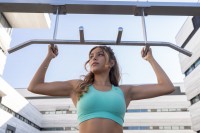


Owners of a pull-up bar who wish to learn new pull-up variations will find the appropriate information here. This blog post describes a highly effective, simple training plan for learning pull-up variations and simultaneously lists the most common pull-up techniques.
A short FAQ list can be found at the end of the post. Any missing information or additional questions can easily be submitted via the comment section.
If a personalized training schedule is required, a visit to fitnessgpt.net (a service for tailored training plans) is highly recommended.
Before delving fully into the details, it must be noted that for prolonged workouts, grip strength generally represents the primary limiting factor for all pull-up variations.
A practical solution for this challenge is provided by the Dr. Dreh pull-up bar and high-quality resistance bands, as described in the following Equipment and Accessories section. These tools enable targeted and optimized grip strength training, based on proven practical experience.
Equipment and Accessories
As previously mentioned, the following equipment is exceptionally beneficial for a rapid and targeted increase in grip strength:
-
For dedicated grip strength training, the Dr. Dreh pull-up bar is highly recommended. Link: View the Dr. Dreh pull-up bar at klimmzugstangen.de
-
To safely increase the number of repetitions across various exercises, resistance bands are an ideal choice. Link: View resistance bands at klimmzugstangen.de
Training Plan for Learning Pull-Up Variations
Below is a structured training plan designed for mastering pull-up variations. The routine assumes an existing capability of performing 2 to 5 consecutive pull-ups. The primary goal is the systematic development of essential base strength.
The program utilizes "cluster sets" (multiple sets consisting of very few repetitions) to efficiently build and enhance base strength. New pull-up variations are introduced with technically clean execution through supported methods (e.g., using bands or gymnastics rings).
For beginners, it is crucial to perform appropriate warm-up and cool-down routines before and after the exercises shown below. This practice is absolutely essential for preventing potential injuries.
Flowchart: Building Base Strength & Variations

Table: Building Base Strength & Variations
| Exercise | Sets & Reps | Rest |
|---|---|---|
| 1. Neutral Pull-Ups (Hammer Grip) Focus: Base Strength & Volume (Cluster Method: Not to failure) | 5 x 2 Reps | 90-120 sec |
| 2. Commando Pull-Ups Focus: Variation & Core Stability Use a resistance band if necessary | 3 x 4-6 Reps (per side) | 120 sec |
| 3. Ring Pull-Ups (or on suspension trainer) Focus: Joint Health & Rotation Alternative: Negative execution | 3 x Max (technically clean) | 90 sec |
| 4. Isometric Hold (Chin over bar) Focus: Static Strength | 3 x Max Time (Target: > 10 sec) | 90 sec |
| 5. Parallel Bar Dips Focus: Antagonist (Pushing movement) | 3 x 5-8 Reps | 90 sec |
Exercise Execution Guidelines
1. Neutral Pull-Ups (Hammer Grip)
Execution: The parallel handles of the pull-up bar or gymnastics rings are gripped with palms facing each other. The body is pulled up in a controlled manner until the chin clears the hands, followed by a slow, controlled descent.
Effect: Primarily trains the latissimus and the brachialis (upper arm). This variant often allows for greater force production compared to the wide overhand grip.
Alternative: Underhand pull-ups (chin-ups) or lat pulldowns (if a machine is available).
2. Commando Pull-Ups
Execution: A position is taken directly underneath and perpendicular to the bar. One hand utilizes an underhand grip, while the other utilizes an overhand grip placed directly in front of it (mixed grip). The head is pulled up past the side of the bar. The side of the head or the grip position must be alternated after every set.
Effect: Challenges the latissimus from a completely different angle while heavily engaging core stability (anti-rotation) and grip strength.
Alternative: Close-grip underhand pull-ups or unilateral ring rows.
3. Ring Pull-Ups
Execution: The movement initiates from a dead hang on the rings with palms facing forward (pronation). During the upward pull, the hands rotate naturally so the palms face each other or the body (supination).
Effect: Highly gentle on the elbows and shoulders due to the unrestricted free rotation. Intensively activates both the biceps and the entire back musculature.
Alternative: Ring rows (with the body positioned closer to horizontal to increase the load).
4. Isometric Hold
Execution: The peak position of the pull-up (chin strictly over the bar) is reached by jumping or utilizing an aid (e.g., a chair). This position must be held under maximum muscular tension for as long as possible.
Effect: Specifically targets and strengthens the weakest point of the movement (the "lock-out") and builds massive static holding capacity.
Alternative: Negative repetitions (a slow, controlled lowering phase from the top position).
5. Parallel Bar Dips
Execution: The body is supported on the parallel bars with straight, locked arms. A controlled descent is performed until the elbows reach an approximate 90-degree angle, followed by a strong pushing movement back to the starting position.
Effect: Trains the triceps, pectoral muscles, and anterior deltoids. It serves as a necessary antagonistic (pushing) movement to balance the heavy pulling exercises.
Alternative: Push-ups or bench dips.
General Training Plan Guidelines
When current capability lies between 2 and 5 pull-ups, technical precision remains the absolute priority for properly activating the target muscles. Therefore, the following principles must be strictly observed:
-
Technique and Posture: Momentum (kipping) must be completely avoided. Exercises should be executed with strict form. Core and glute muscles must be engaged to prevent an arched back and swinging legs. Quality of movement always takes precedence over repetition quantity.
-
Range of Motion: Every single repetition must begin from a full dead hang (arms entirely extended) and conclude with the chin above the bar. Partial repetitions fail to build complete structural strength and frequently lead to training plateaus.
-
Grip Strength: Grip strength requires dedicated attention, as pulling power is entirely dependent on holding capacity. At the end of a session, a passive hang from the bar should be maintained until the forearms are fully fatigued.
-
Utilize Assistance: To effectively learn new variations, resistance bands matching the current strength level are highly recommended. This enables the practice of demanding movements like commando pull-ups for more than two repetitions while maintaining perfect form.
-
Progression: Progressive overload is the key to continuous strength gains. The number of sets (clusters) should be increased first, followed by an increase in training frequency, and finally the overall training duration.
-
Recovery: Adequate rest is paramount. At least one full rest day must be scheduled between training sessions to ensure proper muscle regeneration and adaptation.
Overview of Pull-Up Variations
This comprehensive overview encompasses nearly all available pull-up variations. Should any significant technique be missing, it can readily be added via the comment section.
1. By Grip Type (Hand Position)
The grip type primarily determines which muscle groups (latissimus, biceps, or forearms) bear the heaviest load. This specific focus is detailed for each individual variation below.
-
Classic Pull-Up (Overhand Grip) on a straight bar: Palms face away from the body. Focus: Latissimus (width) and the upper back region.
-
Classic Pull-Up (Overhand Grip) on a curved bar: Palms face away from the body, allowing for a more natural wrist alignment. Focus: Latissimus and upper back. This provides significantly reduced strain on the wrists and shoulder joints due to an ergonomic pulling angle.
-
Chin-Up (Underhand Grip): Palms face towards the body. Focus: Biceps and the lower latissimus. This is typically the most powerful variation for beginners.
-
Neutral Grip (Hammer Grip / Parallel Grip): Palms face each other. This requires a bar equipped with parallel attachments. Focus: Brachialis (upper arm) and latissimus. Highly beneficial and safe for shoulder joint health.
-
Mixed Grip: One hand utilizes an overhand grip, the other an underhand grip. Often applied to prevent hand slipping when using heavy additional weights or to address specific muscular imbalances.
-
V-Grip (Gironda Grip): Performed with a V-grip attachment draped over the bar. Similar to the neutral grip, but usually narrower and targeting the mid-back area more intensely.
2. By Grip Width
The width of the grip dictates the mechanical leverage and the overall range of motion (ROM) for the following variations.
-
Shoulder-Width Grip: The standard execution, providing the optimal balance between force production and joint range of motion.
-
Wide Grip: Hands are positioned substantially wider than shoulder-width. This shortens the pulling distance and highly isolates the upper latissimus, but increases difficulty and structural shoulder stress.
-
Close Grip: Hands are placed almost touching. The workload shifts significantly towards the arms (biceps/brachialis) and the inner/lower sections of the latissimus.
3. By Movement Pattern (Technique & Angle)
These dynamic variations alter the core geometry of the movement, deviating from a standard vertical pull to incorporate lateral or circular motions.
-
Archer Pull-Ups: The body is pulled toward one specific side while the opposite arm extends straight out (mimicking the drawing of a bow). This serves as a vital primary progression for the one-arm pull-up.
-
Typewriter Pull-Ups: Following an initial vertical pull, the body is moved horizontally from left to right in the top position without losing elevation.
-
Around the World: A circular, continuous motion where the body is pulled toward the left hand, shifted smoothly across to the right hand, and then lowered.
-
Commando Pull-Ups: The body is positioned perpendicular to the bar (the bar aligns directly over the head) using a staggered close neutral grip. The head clears the bar alternating left and right on each consecutive repetition.
-
L-Sit Pull-Up: Executed with the legs rigidly extended forward at a 90-degree angle, placing immense functional demand on the core musculature.
-
Hollow Body Pull-Up: The strict gymnastic standard. The pelvis is tucked, legs are squeezed together, and the body maintains a slight C-shape curve. This requires maximum total-body tension.
-
High Pull-Up (Explosive): The objective shifts from merely clearing the chin to pulling the lower chest or even the navel forcefully up to the bar. This explosive power generation is a prerequisite for advanced skills like muscle-ups.
-
Gironda Sternum Pull-Up: The torso leans extremely far backward (achieving a near-horizontal angle) while the lower sternum is pulled to the bar, resulting in an unmatched latissimus contraction.
4. By Difficulty Level (Progressions)
For Beginners (Regressions):
-
Scapular Pull-Ups: Movement is initiated purely by depressing the shoulder blades while the arms remain fully locked out. Excellent for mastering the initial pull phase and building back awareness.
-
Negative Pull-Ups: Reaching the top position via a jump or step, followed by a highly controlled, slow descent (lasting approximately 5 seconds).
-
Band-Assisted Pull-Ups: Resistance bands are looped securely around the feet or knees to offset a portion of body weight, allowing for full range of motion practice.
-
Australian Pull-Ups (Bodyweight Rows): A horizontal pulling movement performed on a low bar or rings with the feet firmly planted on the floor.
For Advanced Athletes (Skills):
-
One Arm Pull-Up (OAP): The ultimate benchmark of pulling strength. A full, unassisted pull-up utilizing only a single arm.
-
Mantle Pull-Up: One arm performs the primary heavy pull while the other provides minimal stabilization on the bar or a hanging rope. An essential stepping stone to the OAP.
-
Muscle-Up: A complex, explosive maneuver combining a high pull-up directly into a straight-bar dip transition.
-
Front Lever Pull-Up: While holding a static horizontal hang (front lever), the body is pulled straight upward. This places an extraordinary, elite-level load on the latissimus.
-
Clapping Pull-Up: An explosive pull generating enough vertical momentum to release the bar, clap the hands together, and safely catch the bar again on the descent.
5. By Equipment (Grip Strength Focus)
While a standard bar is the classic tool, pull-ups can be executed on various specialized implements to target specific physiological adaptations.
-
Ring Pull-Ups: Performed on gymnastics rings. This variation is remarkably joint-friendly due to the natural rotation of the hands but demands significantly greater core and shoulder stabilization.
-
Towel Pull-Ups: One or two thick towels are draped over the bar and gripped securely. This represents a massive, specialized challenge to grip and forearm strength.
-
Rope Climbs: Vertical pulling utilizing a thick, textured climbing rope.
-
Fat Gripz Pull-Ups: Executed on a bar with a heavily enlarged diameter, shifting the physiological demand almost entirely to the forearm and hand musculature.
-
Finger-Board (Hangboard): Pulling from narrow ledges using only 1, 2, or 3 fingers. Specifically designed for rock climbers, this carries a high risk of tendon injury and requires extreme caution and gradual conditioning.
6. Special CrossFit Variations (Note: Technique Focus)
The following methods intentionally incorporate bodily momentum to maximize repetition volume. They are predominantly utilized for metabolic conditioning or competitive scenarios, rather than strict muscle hypertrophy.
-
Kipping Pull-Ups: Generating momentum from the hips and core to mechanically assist the upward pull and substantially increase total repetitions.
-
Butterfly Pull-Ups: A continuous, cyclic, and highly dynamic movement pattern meticulously optimized for maximum execution speed during competitions.
Frequently Asked Questions (FAQ) Regarding Pull-Up Training
1. What is the optimal training frequency for pull-ups?
For rapid neuromuscular adaptation and skill acquisition, daily practice utilizing low repetitions while strictly avoiding muscle failure ("Grease the Groove" method) is highly effective. For structural muscle hypertrophy, 2 to 3 intense sessions per week, interspersed with adequate rest days, represent the ideal approach.
2. Which is superior: Wide overhand grip or close underhand grip?
A shoulder-width overhand grip is generally recognized as the best option for comprehensive back development and maintaining long-term shoulder health. The close underhand grip (chin-up) more heavily recruits the biceps, making it a more accessible and stronger starting point for beginners.
3. What steps should be taken if a single pull-up is currently unachievable?
The primary focus must shift to "negative repetitions". This involves jumping to the top position (chin positioned over the bar) and executing a smooth, strictly controlled descent lasting between 3 and 5 seconds.
4. What practical alternatives exist when no pull-up bar is available?
A highly practical substitute involves lying underneath a sturdy, heavy table, gripping the edge, and performing an upward pulling motion (Australian pull-ups / inverted rows). Alternatively, gymnastics rings suspended securely from an exposed beam or a strong tree branch serve as an excellent, portable solution.
5. What causes stagnation at a specific repetition count?
Plateaus inevitably occur when the nervous system and musculature fully adapt to a specific training stimulus. To break through this, intensity must be elevated by incorporating external resistance (such as weighted vests or dip belts) or by utilizing structured "cluster sets" (e.g., performing 2 repetitions, taking a 10-second pause, followed by 2 more repetitions) to safely and effectively increase total training volume.