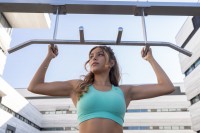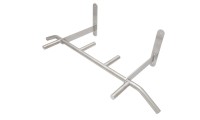


For a woman, doing a pull-up is a huge milestone. But why do so many women find pull-ups and other exercises on the bar so difficult? This article explains the physical and biological reasons and shows you how any woman can easily learn to do at least one pull-up.
If you want the short version, check out our article on the "Pull-Up Bar – A Piece of Training Equipment for Men & Women". If you need a pull-up bar, you'll find what you're looking for here: klimmzugstangen.de. At the very bottom of this page, you'll also find a workout plan to help you learn pull-ups as a woman. If needed, we can also create a personalized pull-up training plan for you.
Women and Pull-Ups: The Background
Studies show that very few women can do pull-ups [1]. This is primarily due to a woman's physical capacity, which is, on average, about 2/3 that of a man's. Despite this difference, a woman's ability to do a pull-up is the result of a complex interplay of several factors.
On one hand, this ability is determined by genetics. The most important factors are: body size, body composition, bone length, and muscle fiber makeup. On the other hand, psychological factors like motivation, willpower, current well-being, and one's general attitude toward physical activity play a major role. Finally, environmental factors like nutrition and training also have a significant influence on whether you can do pull-ups.
Of all these factors, arm and core strength are the most important.
Body Size
Body size is a key factor in the mechanics of a pull-up. The larger the body, the more weight there is to lift and the more work must be done to complete a pull-up. Women are generally smaller and lighter than men—on average, 13 cm (about 5 in) shorter and around 16 kg (about 35 lbs) lighter [2]. This means that, in absolute terms, women generally need less force to do a pull-up.
Body Shape
It's well known that women have a different body shape than men. Women often have wider hips and narrower shoulders. As a result, a woman's center of gravity is slightly lower than a man's. At first glance, this seems like a disadvantage. However, since women also tend to have shorter arms in absolute terms, they can work with a shorter lever than men, who must generate more force with longer arms (a longer lever) to lift the same amount of weight.
Musculature
Women have demonstrably less muscle mass than men. In addition, women have more body fat—depending on age, up to 10% more than men. This fat is distributed under the skin, between organs, and is also stored in muscles. It's this fat storage that results in women being able to generate significantly less force. It's often mistakenly assumed that muscle fiber types (fast-twitch and slow-twitch) are also a decisive factor in force production for women. This is not the case. According to the latest scientific findings, muscle fiber types occur more or less equally in men and women and are not gender-specific, but genetically determined.
Men and women also have different hormonal balances, which significantly affects the ability to do pull-ups. This becomes especially apparent after puberty. For example, strength levels between boys and girls are roughly equal until puberty. It is only with puberty and the increased production of the male sex hormone testosterone that boys develop significantly more strength. As a result, adult women often cannot achieve the same level in all three strength attributes (maximal strength, explosive power, and strength endurance).
However, regular training and physical activity, in general, influence the hormonal system. This creates a two-way relationship between physical performance and hormones.
Despite the Challenges: How to Build Your Foundation
Even though many women don't have the ideal physical and biological prerequisites for pull-ups compared to men, any woman can learn to do them relatively easily. To do so, you just have to strategically leverage the factors mentioned above.
You obviously can't change your height or basic body shape. However, you can make a big difference in your body composition, especially the ratio of muscle to fat. A woman can do this through a targeted, healthy diet combined with aerobic training. Together, these two things are very effective at reducing overall body fat percentage.
Overall, your energy requirements should be considered. The following table gives a good overview of the energy consumption for a woman (column "f"). This means if you are 30 years old, work in an office, and have a largely sedentary job (PAL value of 1.4), you will burn around 1700 kcal/day as a woman.
Adults (by age) | Guideline Values for Energy Intake | |||||
|---|---|---|---|---|---|---|
in kcal/day | ||||||
PAL Value 1.4 | PAL Value 1.6 | PAL Value 1.8 | ||||
m | f | m | f | m | f | |
19 to 25 years | 2400 | 1900 | 2800 | 2200 | 3100 | 2500 |
25 to 51 years | 2300 | 1800 | 2700 | 2100 | 3000 | 2400 |
51 to 65 years | 2200 | 1700 | 2500 | 2000 | 2800 | 2200 |
65 years and older | 2100 | 1700 | 2500 | 1900 | 2800 | 2100 |
The PAL values shown are a measure of physical activity (PAL stands for physical activity level). They are defined below for different activities.
For sports activities, an additional 0.3 PAL units can be added to the values shown per day. For a woman (age: 30) with a job that involves mostly standing and walking, plus athletic activity, this would result in a PAL value of 2.0. This level of physical activity means a normal energy expenditure of approximately 2500 kcal/day. For more information, see [3].
Work Intensity and Leisure Activity | PAL | Example Professions |
|---|---|---|
Mostly sedentary work with no strenuous leisure activity | 1.4 - 1.5 | Office workers, drivers, precision mechanics |
Sedentary work with additional energy needs for walking or standing tasks. Little to no strenuous leisure activity | 1.6 - 1.7 | Lab technicians, students, professors, assembly line workers |
Mostly standing and walking work with no strenuous leisure activity | 1.8 - 1.9 | Waiters, salesclerks, mechanics, construction workers |
With these values, you can use a simple calculation: If my daily calorie intake exceeds my daily calorie needs, I will gain weight. If I consume fewer calories than my body requires, I will lose weight.
So, if I consume fewer calories than my body needs and also go for a 45-60 minute run, I will reduce my overall body fat percentage. If I also train for maximal or explosive strength, I can further improve my muscle-to-fat ratio in a way that helps with pull-ups.
Keep in mind that most of us underestimate our calorie intake! Pay close attention to the calories in your diet and, most importantly, avoid all sweetened drinks. It's best to drink plenty of water, tea, coffee, or other classic beverages.
For pull-ups, a targeted muscle-building workout for the arms and core is best. Bodyweight exercises, classic circuit training, or a calisthenics workout that includes pull-ups and similar exercises are all excellent choices.
It's important to note: Women do not need special training methods. A woman's muscles also need to be sufficiently challenged to trigger muscle growth. And women also need to take long enough breaks between training sessions—48 hours or more, depending on the intensity—so that the next workout can have a similar effect.
Learning to Do Pull-Ups
Learning to do pull-ups as a woman is simple: grip the pull-up bar so that your thumbs wrap around the bar, not resting on top of it. Then, from a dead hang on the pull-up bar, pull your chin over the bar (this is the hard part) and then slowly lower your body back down until your arms are fully extended again.
If you don't have the strength for that yet, here are a few options.
Method 1 for Women to Learn Pull-Ups
The easiest way to learn pull-ups is with negative pull-ups. To do this, grip the bar with your chin already above it (you can use a stool to get into position) and then slowly lower your body down until your arms are fully straight. Repeat this exercise up to 10 times for two to three sets, either as part of a circuit, a calisthenics workout, or just on its own as a bodyweight exercise.
Method 2 for Women to Learn Pull-Ups
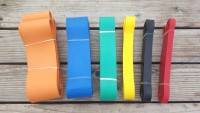
Alternatively, you can use a resistance band to help support your body weight. Loop the resistance band over the pull-up bar and use it as a support (for your foot or knee) during the pull-up, as shown in the picture below. Resistance bands make pull-ups much easier to do and learn.

There are different bands that can provide 75 kg (165 lbs) or more of assistance. For women starting out, bands that provide up to 50% weight assistance are a great choice. After 3-4 weeks of training, you should reduce the assistance to a band that offers up to 25% support to maintain the training effect.
The orange fitness band on the far left of the picture provides the most assistance, and the red one on the far right provides the least. For women, the green or yellow fitness band is a great place to start.

Method 3 for Women to Learn Pull-Ups
Another alternative is a static hold. Hang from the pull-up bar and hold yourself in the top position for 30-60 seconds, or as long as you can. Repeat this exercise 3 to 5 times, or for as long as you have time.
Workout Plan: Learning to Do Pull-Ups for Women
With these three methods, you can create a complete workout plan. You can find such a plan below. Note that the plan includes not only the three basic exercises described but also a warm-up, a cool-down, and an attempt at a real pull-up.
Follow this workout plan twice a week or every other day. After 3 to 4 weeks, you should be able to do your first pull-up. You can find a pull-up bar for your training at the link. Here is the Workout Plan as a PDF.

Conclusion: Women and Pull-Ups
Women are at a clear disadvantage when it comes to pull-ups. The lower muscle mass and higher body fat percentage make it difficult for women to build the necessary strength in daily life. A woman's hormones are also a contributing factor. Despite these disadvantages, women can absolutely do pull-ups. All it takes is targeted training combined with a healthy diet—and from our experience, it's much easier than you might think!
Sources
[1] Why women can't do pull-ups?
[2] Destatis: Body Mass Germany (German)
[4] Photo by GMB Monkey on Unsplash