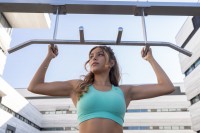


In this article, we'll walk you through four tried-and-true methods for testing your strength-to-bodyweight ratio, so you can get a precise measure of where you stand right now. We’ve drawn inspiration from the community discussion on a video by FormelFroböse and framed it within established fitness standards. And of course, to tackle any of these tests, you’ll need a solid pull-up bar. If you don't have one yet, you can find some seriously sturdy pull-up bars right here.
Get ready: These tests will challenge not just your pulling power, but also your grip strength and core stability.
The Four Tests for Your Strength Check-Up
Test 1: The Max Rep Test
How to Do It
-
The Grip: Grab the bar with an overhand grip (palms facing away from you), slightly wider than your shoulders.
-
Starting Position: Begin from a full dead hang. Your arms should be completely straight, and your shoulders can be relaxed (a passive hang).
-
Execution: Pull yourself up powerfully until your chin is clearly over the bar. Avoid any swinging or kipping. Exhale as you pull up.
-
Finishing & Counting: Lower yourself back down with control until your arms are fully extended again. Only count reps performed with a full range of motion until you hit technical failure.
Why This Test Matters
-
It assesses the relative strength of your lats, biceps, and forearms.
-
It's a great indicator of your upper-body muscular endurance.
Analysis & Benchmarks
Forget the unrealistic numbers you see online. Here are some solid, real-world benchmarks to see where you stack up:
-
Beginner (0-4 Reps): If you’re just starting out and can’t do a pull-up yet, or can only manage a few, you're in the right place. This is the most common starting point and a fantastic baseline for measuring progress.
-
Intermediate (5-12 Reps): Nailing this many reps shows you’ve built solid upper-body strength. This range was also typical for experienced lifters in the video's community discussion.
-
Advanced / Elite (>15 Reps for Men / >8 Reps for Women): This is an excellent level of strength that requires a high degree of training and discipline.
Test 2: The Timed Rep Test (Max Reps in a Fixed Time)
How to Do It
-
Set a timer for 60 seconds and perform as many clean pull-ups as you can in that time. The same form rules from Test 1 apply.
Why This Test Matters
-
It measures your explosive power and your resistance to fatigue.
-
It prevents you from "grinding out" individual reps too slowly.
Analysis & Benchmarks
This test reveals your ability to generate force quickly and use rest periods efficiently. Hitting 10-15 clean reps in 60 seconds is a strong result.
(Side note: The claim of "52 reps in 20 seconds" from the YouTube comments is physically impossible with proper form and should be taken as a joke or a misunderstanding.)
Test 3: The Dead Hang Test (Isometric Hold)
How to Do It
-
Grab the bar and simply hang (a passive hang) to primarily test your grip strength. For extra core and shoulder activation, actively pull your shoulder blades down and back (an active hang).
-
Hold this position for as long as possible with straight arms, until your grip gives out.
Why This Test Matters
-
It’s a direct measure of your max grip strength and shoulder stability.
-
It's perfect for beginners who can't yet do a full pull-up.
Analysis & Benchmarks
Your hang time is a direct indicator of your grip strength—the foundation for every pull-up.
-
Good Start: 30 seconds
-
Advanced: 60 seconds
-
Excellent: Over 90 seconds
An interesting example from the community was a user who could hang for 2 minutes but couldn't do a single pull-up. This proves an important point: strong grip is necessary, but not sufficient, for the pull.
Here's the video (in German) from FormelFroböse, where they break down the test.
Test 4: The Weighted Pull-Up 1-Rep Max (1RM)
WARNING: This test is for advanced athletes only who can already perform multiple clean bodyweight pull-ups. Always warm up thoroughly!
How to Do It
-
Warm up with a few sets of regular, bodyweight pull-ups.
-
Strap on a dip belt and start with a light weight (e.g., 5 kg / 10 lbs).
-
Perform one clean rep. Increase the weight in small increments, taking plenty of rest (2-3 minutes) between attempts.
-
Your 1-Rep Max (1RM) is the heaviest weight you can lift for exactly one clean rep. Your total strength score is: Bodyweight + Added Weight.
-
A Safer Alternative: Find your 3- to 5-rep max (the weight you can lift 3-5 times) and use an online 1RM calculator to estimate your max. This significantly reduces the risk of injury.
Why This Test Matters
-
It measures the absolute peak strength of your pulling muscles.
Analysis & Benchmarks
The 1RM is the gold standard for measuring maximum strength.
-
Advanced: Adding 25-40% of your bodyweight is a powerful goal.
-
Elite: Pulling more than 50% of your bodyweight in added weight is a sign of outstanding strength.
The Takeaway: Your Path to Getting Stronger
A pull-up bar is more than just a piece of equipment—it's an honest measuring stick. Whether you want to test your max strength, endurance, or grip, it gives you immediate, measurable feedback on your progress. Every extra rep you achieve and every second longer you hang is direct proof that you're getting stronger.
What's Next? Your Next Step
-
For Beginners: Start with the Dead Hang Test and work your way up to 60 seconds. It's the perfect foundation.
-
For Intermediates: Choose the Max Rep Test and re-test yourself every 4-6 weeks to track your gains.
Still can't do a single pull-up? No problem! Our guide will show you exactly how to get there:
How to Learn and Master Pull-Ups: A Guide for Beginners and Advanced Lifters
Which test are you going to try? Drop your results and goals in the comments below!
Source & Community Examples
The following table shows a few unedited comments from the YouTube thread mentioned earlier. It serves as a snapshot of the discussion, not a scientific data set.
| Username | Pull-Ups | Time [s] | Note / Source (Comment) |
|---|---|---|---|
| @Fabian‑rk7xk | 52 | 20 | “52 pull-ups in 20 seconds” |
| @pupupupu7323 | 20 | 45 | “20 pull-ups in 45 sec” |
| @LucaSchmidt‑fp3cx | 17 | N/A | “17 pull-ups in a row” |
| @faurby999 | 13 | 40 | “13 clean pull-ups … in 40 sec” |
| @orco500 | 8 | N/A | “Wide grip pull-ups – I can do about 8” |
| @petraschute8179 | 8 | N/A | “Unfortunately, only 8 reps…” |
| @J3anne_dArc | 0 | — | “…but with this test I’d still be at zero” |
| @LinAuditore | 0 | — | “…I can’t even do one pull-up” |
| @DurstDevel | 0 | — | “Not a single pull-up” |
Photo by Milan Csizmadia on Unsplash