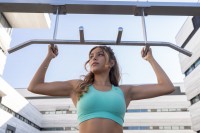


Pull-ups are among the best fundamental exercises in fitness, calisthenics, CrossFit, or strength training. They are ideal for building muscle mass or increasing maximum strength and should be part of every training plan. With pull-ups, you train the entire upper body, shoulders, back, forearms, and especially the biceps – and with the right knowledge, it’s easy.
In this blog post
- Where is the best place to do pull-ups?
- How many pull-ups are normal and achievable?
- Pull-up training: What’s the best approach?
- Skills, exercises, and techniques for your first pull-ups
- When does the body build muscle?
Where is the best place to do pull-ups?
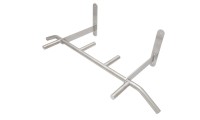
The best way to do pull-ups is on a pull-up bar. You can find excellent pull-up bars at klimmzugstangen.de.
As a temporary solution, you can also do pull-ups on a tree branch, the top edge of your door, or the edge of a cantilevered staircase. This works fine for a while, but for long-term and serious home training, a firmly mounted pull-up bar on the ceiling, wall, between two walls, or on a beam is much more comfortable.
There are many different types of pull-up bars: simple, multifunctional, cheap, expensive, made in China, or made in Germany. Every pull-up bar has its pros and cons. If you’re on a budget, a doorway pull-up bar for hanging can be a good starting point. It’s not ideal for pull-ups and real fitness training, but at around €50, it’s affordable.
If you want a proper pull-up bar – one with multiple grip options, great compatibility with other fitness equipment, and an attractive design – check out the shop at klimmzugstangen.de. There you can buy a pull-up bar for almost any mounting option at home, starting from €68.
Klimmzüge bzw. Pull-ups gehören zu den besten Grundübungen beim Fitness, Calisthenics, Crossfit oder beim Krafttraining. Sie sind ideal für den Muskelaufbau oder die Erhöhung der Maximalkraft und sollten in keinem Trainingsplan fehlen. Mit Klimmzügen trainierst du den gesamten Oberkörper, die Schultern, den Rücken, die Unterarme und vor allem den Bizeps - und mit dem richtigen Wissen geht das ganz einfach.
In diesem Blogbeitrag
Wo am besten Klimmzüge machen?
Wie viele Klimmzüge sind normal und möglich?
Klimmzüge trainieren: Wie am besten vorgehen?
Fähigkeiten, Übungen und Skills für erste Klimmzüge
Wann baut der Körper Muskeln auf?
Wo am besten Klimmzüge machen?
Klimmzüge machst du am besten an einer Klimmzugstange. Sehr gute Klimmzugstangen findest du auf klimmzugstangen.de.
Als Notlösung kannst du Klimmzüge auch an einem Baum, an der Oberkante deiner Tür oder an der Treppenkante deiner freitragenden Treppe machen. Das geht allemal. Auf Dauer und für ein echtes Training zu Hause ist eine fest verschraubte Klimmzugstange an Decke, Wand, zwischen zwei Wänden oder einem Balken deutlich angenehmer.
Es gibt viele verschiedene Klimmzugstangen: einfache, multifunktionale, billige, teure, Made in China oder Made in Germany. Jede Klimmzugstange hat Vor- und Nachteile. Beim kleinen Geldbeutel reicht eine Klimmzugstange für die Tür zum Einhängen für den Anfang aus. Sie ist nicht ideal für Klimmzüge und echtes Fitnesstraining, kostet aber mit 50 EUR auch nicht die Welt.
Wenn du eine richtige Klimmzugstange kaufen möchtest, eine mit viele Griffmöglichkeiten, die super mit anderen Fitnessgeräten ergänzbar ist und sich auch sehen lassen kann, dann schaue im Shop von klimmzugstangen.de vorbei. Dort kannst du eine Klimmzugstange für fast deine Befestigungsmöglichkeiten zu Hause bereits ab 68 EUR kaufen.

How many pull-ups are normal and achievable?
As a fitness beginner, you probably can’t do any pull-ups or just a few. That’s completely normal. However, this is not set in stone. You, me, anyone can build the necessary strength for pull-ups and achieve the desired number in just a few weeks with a proper training plan.
If you, as a man, can already do five clean pull-ups in a row, you can increase to 20 pull-ups in eight weeks. Starting from zero pull-ups will take around 12 weeks. For women, it generally takes longer in both cases. How women can learn pull-ups is described here.
If you can already do five pull-ups, you already have good upper body strength. Most gymnasts, athletes, bodybuilders, and calisthenics practitioners can do 10 to 25 pull-ups in a row. Anything beyond that is very good and specifically trained.
Pull-up Training: Basics for Beginners and Pros
As a beginner with zero pull-ups, it’s best to start with Australian Pull-Ups (also called bodyweight rows) or Assisted Pull-Ups. If you don’t know these exercises yet, scroll down; they are briefly described there.
Once you can cleanly do six to eight pull-ups in a row on a pull-up bar, hanging and without any assistance, you won’t make significant progress with Australian Pull-Ups or Assisted Pull-Ups anymore. From this level, continue with the training plan below using regular pull-ups, i.e., hanging and without any assistance.
If you, as a beginner or pro, can already do five regular pull-ups in a row, train pull-ups specifically with regular pull-ups and later, if needed, with weighted pull-ups.
Pull-up Training Plan KT and KT+ for Beginners and Pros
Pull-up Training / Pull-up Training Plan (KT) – with 10 pull-ups as maximum strength:
Every 2-3 days, 5 sets with the following distribution: 4 sets x 6 pull-ups, 1 set x as many pull-ups as possible (to muscle failure).

Determining Your Maximum for the Pull-Up Training Plan (KT)
For training pull-ups with the KT training plan, it’s important to first determine how many pull-ups (regular pull-ups in a hang position or Australian Pull-Ups / inclined pull-ups) you can do at maximum.
To do this, go to the pull-up bar and perform as many pull-ups in a row as possible — that means until muscle failure or until you truly cannot do another rep. Perform your maximum possible pull-ups in a hang position (as a pro or a good beginner) or in an inclined position (as a beginner with zero pull-ups in the arms).
If, as in the example above, you can do a maximum of 10 pull-ups in a row, then do six pull-ups in each of the first four sets (seven or eight would also be fine).
In general, you should train with 60% to 80% of your maximum strength in order to build muscle effectively and in a targeted way. This means the training plan for muscle building — and specifically for increasing the number of pull-ups — looks like this:
Pull-Up Training / Pull-Up Training Plan (KT) – General
Every 2–3 days: 5 sets with the following structure: 4 sets with 60–80% of your maximum pull-ups in a row, 1 set with as many pull-ups as possible (to muscle failure).
Pull-Up Training / Pull-Up Training Plan with Booster (KT+)
Every 2–3 days: 50+ pull-ups in several sets within a maximum of 30 minutes. This means doing as many pull-ups as possible in 30 minutes until, for example, you reach 50 total pull-ups.

Note:
If you can easily do 50 pull-ups in 30 minutes, increase the total to 100, 150, or even more. Conversely, if 50 pull-ups is too much, reduce the total to, for example, 30 pull-ups and then increase it gradually as mentioned before.
Even with the KT+ training plan, it’s advantageous not to perform your maximum possible number of pull-ups in one set. 60–80% of your maximum strength is always a good benchmark for muscle building. For example, if your maximum is eight pull-ups in a row, you should work with around five pull-ups per set until you reach the total number — e.g., 50 pull-ups.
By the way, this is roughly the training plan Arnold Schwarzenegger used in his training to specifically increase the number of his pull-ups [1].
Skills, Exercises, and Drills for Your First Pull-Ups
Australian Pull-Ups / Inclined Pull-Ups
Australian Pull-Ups are, simply put, pull-ups performed at an incline on a pull-up bar set at chest height. They can also be done on gymnastic rings or with a suspension trainer. How to perform an Australian Pull-Up is described below.
For the Australian Pull-Up, position yourself under the pull-up bar and grasp it overhand with both hands so that your chest faces upward and your back is toward the ground. Your feet remain on the ground, pressed lightly together, with legs fully extended, forming a straight line with your body at an angle to the floor.
Alternatively, stand and grasp the pull-up bar overhand with both hands, then take a few steps forward so that your chest or stomach is roughly underneath the pull-up bar.
From this starting position, pull your chest toward the bar until you almost touch it, then lower your body back down. This execution is referred to as Australian Pull-Ups or inclined pull-ups. You can also perform Australian Pull-Ups on parallel dip bars, as shown in the following example.
Advantage of Australian Pull-Ups: You only need to pull a fraction of your body weight. The ratio between the strength in your arms and the reduced body weight to be moved allows you to do 2–3 pull-ups easily — even if you can’t do a single pull-up in a full hang.

Assisted Pull-Ups
Assisted pull-ups are pull-ups performed with the help of a heavy-duty fitness band (also known as a resistance band or pull-up band), typically around 100 cm long and 30 mm to 45 mm wide.
Loop the band directly over the pull-up bar. Then place one foot into the loop and jump up to the pull-up bar into a hanging position, keeping your foot in the band loop. From this starting position, perform a standard pull-up: slowly pull yourself up until your chin is above the bar, then lower yourself back down in a controlled manner until your arms are fully extended.
Typically, a 30 mm wide fitness band is yellow and reduces your body weight by up to 30 kg. A 45 mm wide resistance band is often green and reduces your weight by around 40 kg.
If needed, multiple bands can be attached to the pull-up bar at the same time for greater weight assistance. Fitness bands are an excellent choice for women and beginners to learn pull-ups or to follow the KT training plan.

Weighted Pull-Ups
Weighted pull-ups are pull-ups performed with additional resistance, typically by attaching extra weight to your body. They are useful if you can easily perform around 10 pull-ups in a row and could potentially do 20 or more. To maintain the intensity of each set, wear a weight or dip belt around your hips and attach a small weight plate so that you can only manage around 10 pull-ups per set. Over time, you can gradually increase the weight. Alternatively, you can use a weighted vest, which generally allows you to increase your load by up to 30 kg.
Negative Pull-Ups
Negative pull-ups focus on the lowering phase rather than pulling yourself up. To perform them, stand on a stool or other elevated surface, grip the pull-up bar with both hands, position your chin above the bar, and step off the stool so that you hang freely with your chin over the bar. From this starting position, slowly and under control, lower yourself until your arms are fully extended. This still requires strength but considerably less than pulling yourself up from a dead hang.

When Does the Body Build Muscle?
In general, your body builds muscle effectively when you train at 60% to 80% of your maximum strength. This applies to both men and women.
You can determine your maximum strength (e.g., in your arms) by performing the relevant exercise continuously until you can no longer do another repetition. In the case of pull-ups, this means going to the pull-up bar and performing as many standard pull-ups, Australian pull-ups, or incline pull-ups as possible in one set.
Multiply this number by 0.6 (or by 0.7 or 0.8) to get the 60% performance level, or the required number of repetitions per set for your training plan.
Example: If you can perform 10 pull-ups, start with 6 repetitions per set, because according to the above formula, 6 pull-ups equal 60% of your maximum strength (= 0.6 × 10 pull-ups).
Sources:
[1] Schwarzenegger, A. & Dobbins, B. (1992). The New Encyclopedia of Modern Bodybuilding. Wilhelm Heyne Verlag, Munich.