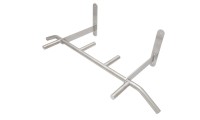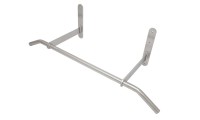


Mounting a Pull-Up Bar Perfectly: Door Frame, Wall, Ceiling, or Beam
Installing a pull-up bar can feel like half a science. This guide explains how to mount a pull-up bar perfectly in a door frame, on the wall, on the ceiling, or on a beam. At the end of the guide, you will also find everything about the right mounting hardware and proper drilling.
Doorway Bars (Door Pull-Up Bar / Telescopic Bar)
Most doorway bars today are telescopic. You can adjust their width by twisting the bar to the desired length, making installation very simple: twist the bar roughly to width, hold it between the mounting points, then twist to the final width so that the bar is firmly wedged inside the door frame.
Some doorway bars feature a quick-release mechanism, similar to quick-releases on bicycles. Mount these in the same way as described above.
Advantages: simplicity and price. A cheaper solution for pull-ups would only be a tree branch or a stair edge at home.
Key limitation: doorway bars do not offer absolute mounting security. Technically, door frames aren’t designed for strong expansion forces; overtightening can damage the frame. Therefore, the bar must be tightened cautiously to avoid excessive tension in the frame.
Because nobody wants to crack a door jamb, most people tighten less than necessary—so bars can slip, and falls happen (sometimes with a bloody nose). Use with care.
Wall-Mounted Pull-Up Bar
To mount a pull-up bar on a wall, you need a solid wall and the right mounting hardware.
How to tell if a wall is solid
Not every wall is solid. First, check the wall construction—ideally by test-drilling. If that’s not possible, ask the builder or tap and listen. In newer buildings, exterior walls are typically solid masonry and stable. Non-load-bearing interior walls are often drywall (Gypsum/Plasterboard). Drywall is not suitable for mounting a pull-up bar (see below).
If your wall is made of concrete, clay brick (solid), full brick, Poroton (perforated clay block), or calcium silicate brick, it is solid masonry and a pull-up bar can be mounted securely.
If your wall is drywall/gypsum board, clay, wattle-and-daub, or a timber stud wall with paneling, it is not solid and is not suitable for a pull-up bar. Even the most robust bar will not hold reliably on such substrates.
Ceiling-Mounted Pull-Up Bar
Even though there is not much that can go wrong with a ceiling mount, always verify that your ceiling is solid.
How to tell if a ceiling is solid
Today, floor/ceiling slabs are generally made of reinforced concrete. Such ceilings are very stable and any properly installed pull-up bar will hold well.
Mounting Hardware & Drilling (Overview)
Use anchors and screws rated for your specific substrate (e.g., concrete anchors for concrete, masonry anchors for solid brick). Drill with the correct diameter and depth per the anchor manufacturer’s instructions, clean the hole of dust, then set the anchor and tighten to the recommended torque.
Special Cases: Ceiling Types in Older and Modern Buildings
In older buildings, floor/ceiling slabs are often a combination of wooden beams and clay plaster. Pull-up bars cannot be mounted directly onto such ceilings. However, if the beams are stable and their direction inside the ceiling is known, the pull-up bar can be mounted directly onto the beam itself.
In some regions, brick insert ceilings are common. A pull-up bar can be mounted securely to these ceilings, as their structure is similar to solid masonry walls.
On suspended ceilings with a solid load-bearing slab above, it is also possible to install a pull-up bar. How to do this and what tools and materials you need is explained in this guide.
The Right Mounting Hardware: Screws and Anchors
Choosing the correct screws and anchors is essential for safe installation. Use heavy-duty anchors matched to the material you are drilling into (e.g., concrete anchors for reinforced concrete, masonry anchors for solid brick). Always drill with the correct diameter and depth according to the anchor manufacturer’s specifications. After drilling, remove dust from the hole before inserting the anchor and tightening the screw to the recommended torque.
The Right Mounting Hardware
Finding the right mounting material can be tricky. In most cases, the combination of a nylon wall plug (anchor) and a wood-thread screw is sufficient for a secure installation. This setup works very well in concrete, solid brick, masonry bricks, sand-lime bricks, Poroton blocks, and other solid walls.
For a pull-up bar, screws and anchors should have a minimum diameter of 8 mm. Alternatively, you could use through bolts, heavy-duty anchors, or expansion anchors. However, this is usually unnecessary, since these anchors are extremely secure and difficult to remove – more than you need for a pull-up bar.
Wooden Beams
Wooden beams are also very well suited for mounting a pull-up bar, and they don’t require wall plugs. However, every screw hole should be pre-drilled with a drill bit that is about 50% smaller than the screw diameter.
Aerated Concrete (Gas Concrete / Porous Concrete)
Pull-up bars can also hold well in aerated concrete walls, but you need to use special anchors, such as Tox VLF anchors or Fischer GB anchors for porous concrete. Standard nylon plugs will not work here.
Drywall (Plasterboard) and Hollow Walls
For plasterboard or other hollow walls, cavity wall anchors are the correct hardware. However, since hollow walls are not structurally strong enough to support a pull-up bar, it does not make sense to mount one there.
How to Drill Correctly
Besides choosing the right screws and plugs, correct drilling is just as important. Keep the following tips in mind:
- For solid walls (stone and concrete), use a masonry drill bit – recognizable by the two small wings on its tip.
- For wooden beams, use a wood drill bit – without wings on the tip.
- Drill bit, wall plug, and screw diameters must match. Example: an “8” marking on drill bit and plug means 8 mm.
- Measure your screws; always check compatibility with plug size.
- Mark the drill depth on the drill bit (plug length + 1 cm).
- For massive walls (concrete, sand-lime brick, etc.), use a hammer drill with the “hammer” setting.
- For wooden beams, pre-drill without hammer mode.
- Collect dust with a bag or vacuum while drilling.
- Drill straight: the drill must be vertical and horizontal (use a level if needed).
- Start slowly, then increase speed as the drill goes deeper.
If you follow these “correct drilling” steps, you will get clean, precise drill holes for your anchors and screws. Finally, tap the wall plugs gently into the hole with a hammer, then screw in the pull-up bar. When mounting to wooden beams, screw directly into the wood without wall plugs.

Titelphoto from cetteup by Unsplash