

Pull-ups and pull-up bars go together like driving and cars. And just like there's a right car for every drive, there's a right pull-up bar for every type of pull-up. This article explains which pull-up bar is the best fit for which pull-ups.
Doorway Bars for Just Pulling Yourself Up
If you don't really want to do proper pull-ups, but just want to pull yourself up every now and then, get a doorway bar. Simply put, doorway bars are tubes with a little padding that can be wedged into a doorframe, as you can see in the picture below.

Doorway bars have a very simple design and are very easy to install. You can choose the height, but you're limited by the height of your door. They don't cost an arm and a leg, either. The following chart shows the price distribution of 28 doorway bars we surveyed in March 2018. Most of them cost between 20 and 30 EUR. On average, a doorway bar costs exactly 23.44 EUR, including shipping. The cheapest one can be had for just 11.99 EUR.

At prices like these, the bars can't be manufactured in Germany. That's why most doorway bars today come from China.
The low prices naturally make doorway bars very appealing. But you shouldn't have high expectations. You'll have to deal with a lot of limitations and be prepared for some surprises. As an athlete and a pull-up expert, I have to say that doing proper, clean pull-ups on a doorway bar is just not possible. Here's why:
Every normal person has to bend their legs when using a doorway bar. It's not a great feeling and it kills your motivation to do pull-ups. The best way to do pull-ups is with your legs straight. It feels much better, especially when you squeeze your legs together.
Doorway bars aren't safe. They are often just held in place by tension in the doorframe. There's no additional screwing into the frame. This means if you buy a doorway bar, you run the risk of falling to the ground without any warning while doing a pull-up. Just check out the classic "Pull Up Bar Fail" video on YouTube.
Wall-to-Wall Pull-Up Bars for Basic Pull-Ups
If you only want to do pull-ups every once in a while, you just need a simple pull-up bar. The simplest ones are gymnastic bars or bars mounted between two walls. The latter are also known as wall-to-wall pull-up bars. Gymnastic bars are relatively complicated to set up—indoors you need floor mounts, and outdoors you need to set the posts in concrete. It's much easier with a bar between two walls, like in the photo below.
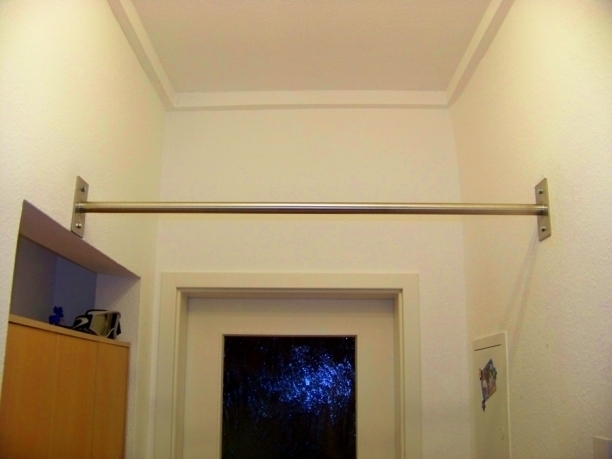
A wall-to-wall pull-up bar like the one in the photo consists of a tube and two wall mounts. The bar is screwed to the walls with the mounts, usually with two screws on each side. This simplicity also means an unbeatable price. We currently offer our wall-to-wall pull-up bar for 79 EUR, and that price includes excellent grip, extreme stability, and top-notch safety.
A wall-to-wall pull-up bar can be installed in any house or apartment with a hallway. You can choose the mounting height freely; you're basically only limited by the ceiling. Another plus: You can also attach suspension trainers, gymnastic rings, ropes, and other similar fitness equipment to these bars.
When you're doing pull-ups, your legs shouldn't touch the ground. This is always the case if you can just barely touch the bar with your fingertips while standing on your tiptoes. So, that's the minimum height you need for a pull-up bar to be able to do proper pull-ups.
Of course, the simplicity of wall-to-wall pull-up bars also has its downsides:
They have to be custom-made for each hallway. That means every wall-to-wall bar is a special order, which we can produce to the millimeter thanks to state-of-the-art technology, made in Germany.
They have a slight give when you're doing pull-ups. Specifically, the bar flexes a little under load due to its design. You can barely feel this effect with a distance of 130 cm (about 51 inches) between the walls. With larger distances, you'll notice it more, which can be a little distracting. We do have a solution for this (a pipe-in-pipe construction), but of course, that's also significantly more expensive.
Wall- or Ceiling-Mounted Bars for a Wide Variety of Pull-Ups
Basic pull-ups include narrow and wide-grip chin-ups and pull-ups. They are perfectly fine for a simple workout. But if you're serious about training with pull-ups or want the greatest possible variety, you need a wall- or ceiling-mounted bar—ideally one with parallel grips and a curved bar.
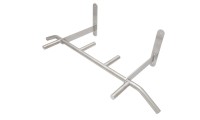
You can see a ceiling-mounted bar, our D4 model, with parallel grips and a curved bar in the following photo.

Parallel grips are the two pairs of grips that are welded to the main bar at a 90° angle. The parallel grips and the curved bar are the key features of this pull-up bar. They are the main difference between this and a wall-to-wall bar or a doorway bar.
Wall- or ceiling-mounted pull-up bars offer up to ten grip variations. They allow for basic pull-ups as well as pull-ups on the curved ends, which are much harder than on a bar that's just a straight tube. They also make parallel-grip pull-ups possible, which are a great alternative to regular pull-ups.
If you've never tried parallel-grip pull-ups, you definitely should. They feel much better and work all the same muscles that are involved in a normal pull-up.
Another key advantage of wall- or ceiling-mounted bars is their stability. Unlike a wall-to-wall bar or a doorway bar, you won't feel any give in the tube. This is especially true for fully welded constructions like the ones we offer.
You can do very clean pull-ups on these "rock-solid" bars without any annoying side effects. That's a huge advantage if you train with pull-ups regularly. You can even do pull-ups on these bars daily.
Pull-ups on wall- or ceiling-mounted bars are more expensive than on doorway bars or wall-to-wall bars. This is due to their construction. On average, a wall- or ceiling-mounted bar currently costs around 189 EUR. The cheapest model is available for 149 EUR, while the most expensive one goes for 268 EUR. The entire price distribution is shown in the following box plot.

Swinging Pull-Up Bars for Swinging Pull-Ups
Swinging pull-ups are done on swinging pull-up bars. In case you didn't know: swinging pull-ups are great for strengthening your entire arm musculature—and are best suited for pull-up pros and anyone who wants to become one.
The reason is the suspension, see the picture below. Unlike wall- or ceiling-mounted bars, doorway bars, or wall-to-wall bars, swinging pull-up bars are connected to the ceiling with ropes or straps. This type of suspension causes a slight swing when you do pull-ups. Anyone who feels this swing automatically tries to compensate for it. This happens subconsciously and works your entire arm musculature. You get a similar training effect, though for the entire body, when you're learning to ride a bike or ice skate.

In a Nutshell
There's a right pull-up bar for every pull-up. "Pull-ups" on doorway bars aren't really pull-ups, they're just pulling yourself up. You won't get really fit or good at pull-ups with a doorway bar. Wall-to-wall pull-up bars allow you to do simple, proper pull-ups for not a lot of money. For very versatile and really clean pull-ups, wall- or ceiling-mounted bars are the best. Really tough pull-ups are swinging pull-ups, which you do on swinging pull-up bars.
Image sources: Paulo Vizeu on Unsplash and klimmzugstangen.de